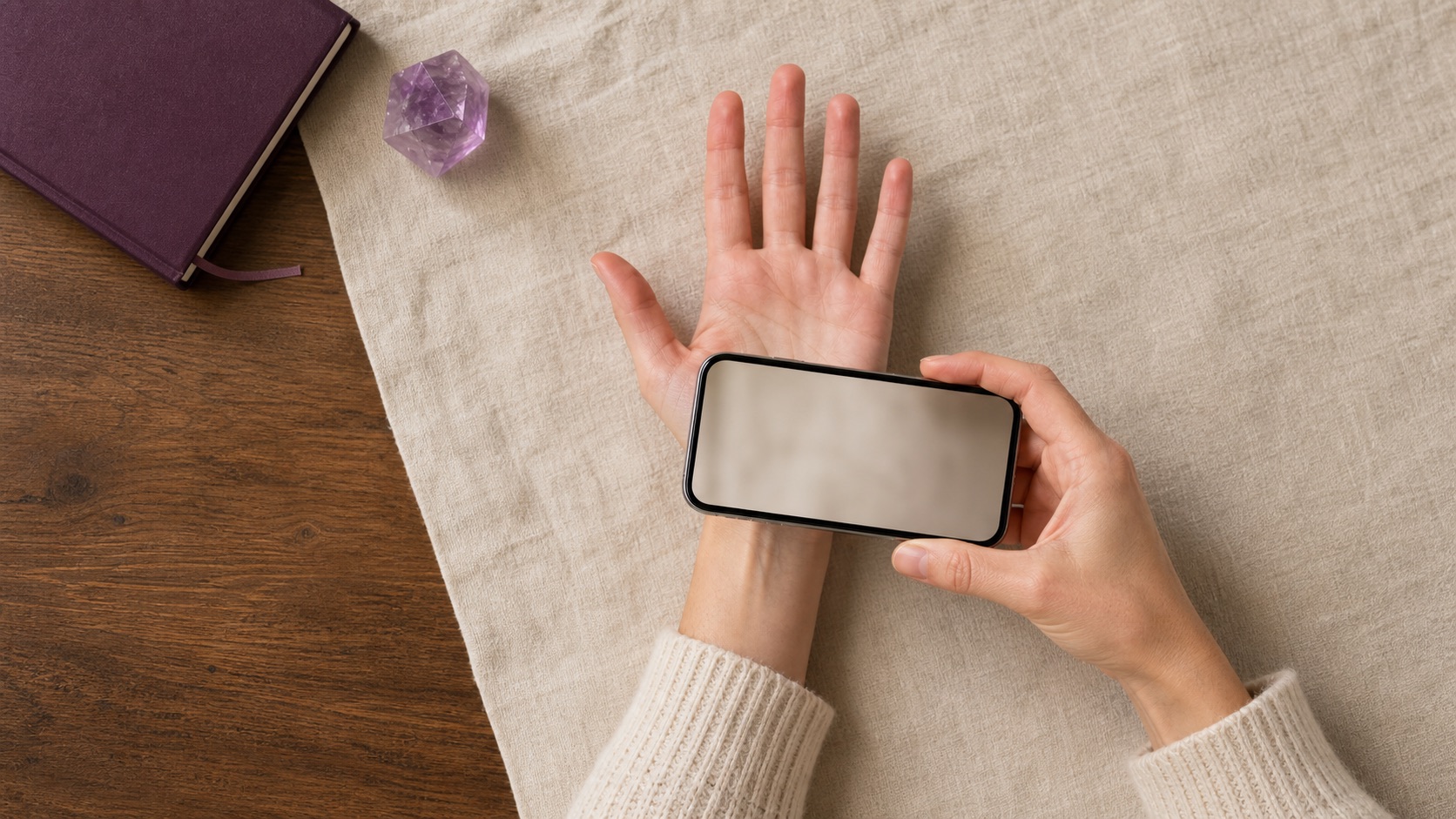
Reading your palm from a photo has one big advantage over reading it live: you can zoom in, study the lines at your own pace, and compare both hands side by side. But the reading is only as good as the photo. This guide shows you how to read palm lines from a photo — starting with how to capture an image the lines actually show up in.
It pairs with the complete palm lines guide, which explains what each line means once you can see it.
Step 1: Choose the Right Hand
In palmistry, your two hands are read for different things:
- Dominant hand (the one you write with): your present-day, active self.
- Non-dominant hand: inherited traits and potential.
Start with your dominant hand, then photograph the other to compare. The left hand vs right hand guide explains how to read the differences.
Step 2: Light It Evenly
Light is everything. The fine lines on your palm disappear under bad lighting.
- Sit near a window with soft daylight, or use a diffuse indoor light.
- Avoid direct glare and harsh overhead spotlights, which wash out the lines.
- Avoid deep shadows — they hide the shorter lines and mounts.
Step 3: Hold Your Hand Flat and Steady
- Relax your hand slightly open and flat. A tightly cupped palm bunches the lines and distorts their length.
- Keep your hand still so the shot stays sharp.
- Don't stretch your fingers hard — natural tension shows the lines truthfully.
Step 4: Fill the Frame and Focus
- Get close enough that your whole palm fills the frame, from wrist to fingertips.
- Tap to focus on the center of your palm so the lines are crisp.
- Skip heavy zoom and filters — they smear the fine detail an accurate reading needs.
- Take two shots: one straight-on of the whole palm, and one closer on the major lines.
Step 5: Read the Lines in Order
Now interpret what you captured:
- Find the heart line — the top horizontal line.
- Find the head line — the middle horizontal line.
- Find the life line — the curve around the thumb.
- Look for a fate line rising toward the middle finger (not everyone has one).
- Read each line's length, depth, and shape, then look at how they relate.
Work slowly. Reading the lines together is where the real picture forms.
Let AI Trace the Lines for You
If you would rather not squint at your own hand, Palmistry Decoder does the tracing for you: take one clear photo and it detects your lines, hand shape, and mounts, then returns a plain-language reading you can save and revisit. The photo tips above still apply — a clear image gives the best reading.
Common Photo Problems
| Problem | Fix |
|---|---|
| Lines too faint to see | Move to soft daylight; avoid overhead glare |
| Blurry image | Tap to focus; steady your hand or rest your elbow |
| Harsh shadows | Face a window; use even, diffuse light |
| Palm looks distorted | Relax your hand flat; don't over-stretch |
Palmistry is a tradition for reflection and entertainment. Once you can capture a clear palm, read it as a prompt for thought — starting with what your palm lines mean.